
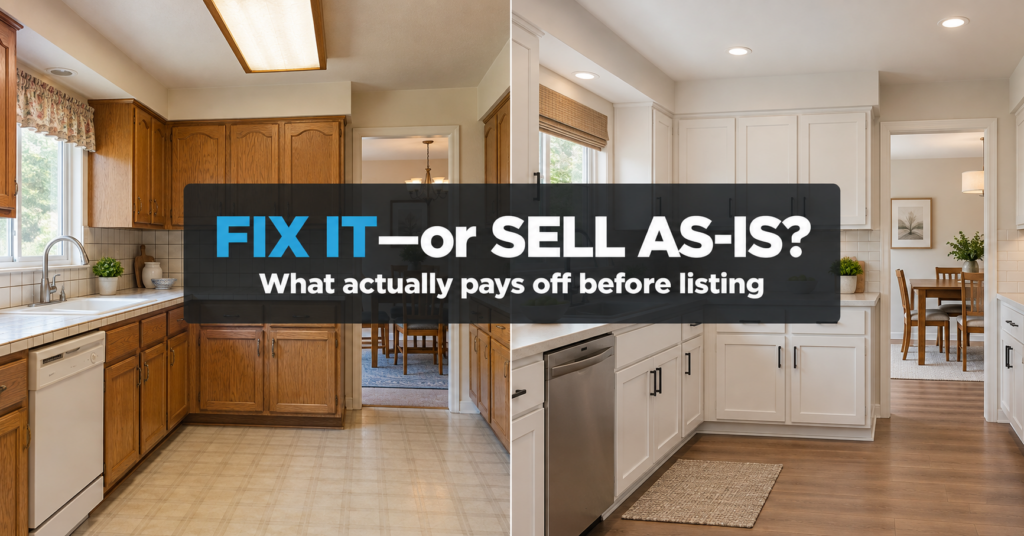
Homeowners are routinely told they need to update everything before putting their house on the market.
Contractors tend to love this advice. Your net proceeds may feel differently.
Some repairs remove legitimate buyer objections and help a home sell faster or for more money. Others consume cash, delay the listing, and replace perfectly acceptable finishes with slightly newer perfectly acceptable finishes.
The goal is not to make your house flawless. The goal is to determine which improvements are likely to produce a meaningful return in price, marketability, speed, or certainty.
Start With Buyer Resistance—not Personal Taste
Sellers often evaluate their homes by asking, “What would I change if I were staying?”
That is usually the wrong question.
The better question is:
What will make a qualified buyer hesitate, reduce an offer, or eliminate this house from consideration?
An older bathroom may not prevent a sale if the home is priced correctly for its condition. An active leak, failing air-conditioning system, serious electrical concern, or obvious unfinished repair creates a different kind of resistance.
One is a matter of taste. The other can affect confidence, financing, insurance, or the buyer’s willingness to move forward.
Those problems should not be treated equally.
Five Questions to Ask Before Spending Money
Before approving a repair or renovation, run it through these five questions.
1. Could the condition affect financing or insurance?
Certain property conditions can become more than cosmetic objections. They may create problems for a buyer’s lender, insurance company, inspector, or appraiser.
That does not automatically mean everything must be replaced. It means the issue deserves a closer look before the house goes on the market.
2. Will buyers notice it immediately?
A buyer may never comment on an older water heater during the first showing. They will notice stained carpet, damaged drywall, strong odors, peeling paint, poor lighting, neglected landscaping, or a front door that looks like it has survived several small wars.
First impressions do not need to be luxurious. They need to communicate that the property has been cared for.
3. What will buyers compare your home against?
Your house does not compete against every home ever sold in The Woodlands. It competes against the homes buyers can purchase now.
If nearby competing listings have renovated kitchens, newer roofs, updated flooring, and strong presentation, your home’s condition will affect its position in that particular market.
If the competition is similarly dated, an expensive remodel may not be necessary. Price and presentation might do more work than construction.
4. Is the likely return greater than the real cost?
A $20,000 project does not create value merely because it cost $20,000.
The calculation should include:
- Contractor costs
- Design and material decisions
- Possible overruns
- Additional mortgage payments
- Taxes, insurance, utilities, and maintenance
- The risk of completing work buyers do not value
- The time lost before entering the market
A project can increase the sale price and still reduce the seller’s final net.
5. How much inconvenience are you willing to accept?
Maximum possible price is not every seller’s only priority.
Some homeowners are willing to manage contractors and delay the sale. Others are dealing with relocation, an inherited property, deferred maintenance, financial pressure, divorce, tenants, or simply a strong desire not to spend the next three months discussing grout colors.
The right strategy must fit both the house and the seller’s situation.
Repairs That Often Deserve Attention
Every property is different, but several types of work frequently provide practical value before listing.
Correct obvious unfinished or broken items
Loose fixtures, damaged doors, missing trim, visible drywall repairs, broken switches, dripping faucets, and half-finished projects can make buyers wonder what else has been neglected.
Finishing several small items may improve buyer confidence without requiring a major renovation.
Reduce inexpensive visual friction
Fresh neutral paint, professional cleaning, improved lighting, new caulk, pressure washing, landscape cleanup, and selective flooring work can materially improve presentation.
These are not glamorous improvements. They simply help buyers concentrate on the house instead of mentally building a repair list during the showing.
Investigate significant concerns before listing
Roof, foundation, water intrusion, plumbing, electrical, and HVAC concerns should be evaluated strategically.
That does not mean automatically replacing every older component. It means understanding the condition, likely buyer reaction, potential financing implications, and available options before the issue appears during negotiations.
Surprises are rarely known for improving a seller’s leverage.
Improvements That Frequently Disappoint Sellers
Some projects sound valuable but deserve more skepticism.
A complete kitchen or bathroom remodel
Major renovations can help when a property is substantially behind its competition, but they also carry high costs and personal design choices.
A buyer may appreciate the new kitchen while privately wondering why anyone selected that backsplash.
Selective improvements may produce a better return than removing everything and starting over.
Replacing functional components solely because they are older
Age matters, but age alone does not always justify replacement.
The condition of the component, expected buyer reaction, insurability, available documentation, pricing strategy, and competing inventory should all be considered before spending the money.
Highly personal upgrades
Luxury fixtures, unusual finishes, elaborate built-ins, specialty rooms, and premium materials may be valuable to the right buyer but unnecessary for the broader market.
The more personal the improvement, the less certain the return.
Fixing everything an inspector might mention
A home inspection is not a demand that an older house become new construction.
Inspectors document conditions. Buyers, sellers, lenders, and insurers determine which conditions actually matter to the transaction.
Trying to eliminate every possible inspection comment is usually unrealistic and expensive.
The Woodlands Is Not One Uniform Market
Buyer expectations vary across The Woodlands.
A home’s village, age, price range, lot, renovation history, nearby competition, and overall condition all influence which improvements may matter.
A buyer evaluating an older home with architectural character may accept finishes that would feel out of place in a newer property competing against recently built inventory.
That is why generic advice such as “replace the kitchen” or “never spend money before selling” is not particularly useful. The decision has to be property-specific.
Compare Three Legitimate Selling Paths
Most homeowners should compare more than one option.
Prepare and list
Complete targeted improvements, improve presentation, and launch the property for maximum exposure.
This may produce the strongest price when the likely return justifies the cost, delay, and effort.
List in its current condition
A home can be marketed without a major renovation when its pricing and positioning reflect the work a buyer may inherit.
This avoids substantial upfront expense while still exposing the property to the open market.
Compare a convenience or as-is offer
An off-market or cash option may provide speed and certainty while avoiding repairs, showings, and extended market exposure.
It will not automatically produce the highest price. That is why it should be compared against the realistic net from listing—not against a fantasy number that ignores repairs, carrying costs, concessions, and selling expenses.
Make the Decision From the Net
The useful number is not the possible sale price. It is the probable net result.
A practical comparison looks like this:
Expected sale price
− repairs and preparation
− carrying costs
− likely concessions
− selling expenses
− the cost and risk of delay
= estimated net proceeds
Then compare that result with the convenience, timing, and certainty offered by the alternatives.
Sometimes improving the property is clearly worthwhile. Sometimes a handful of targeted repairs is enough. Sometimes selling in the current condition is the smarter move.
The answer should come from the property, the competition, and your priorities—not a generic checklist.
Before You Call a Contractor, Diagnose the House
If you are considering selling in The Woodlands or North Houston, start by identifying:
- Which conditions could create real buyer resistance
- Which improvements may increase marketability
- Which projects are unlikely to return their cost
- How the home compares with current competition
- What each selling path may realistically net
Spend money where it changes the outcome. Skip the work that merely makes the house more expensive to sell.
Want a property-specific opinion before you start making repairs? Complete the Market-Ready Check or talk with Sean about the house, your timing, and the options worth comparing.